
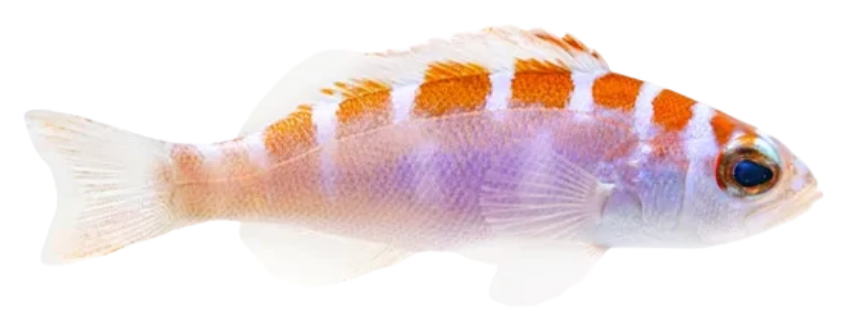
Chalk Basslet
Chalk Basslet (Serranus tortugarum)
Species: Marine Basslet
Growth Form: Small, laterally compressed body; typically reaches 3 inches (8 cm).
Coloration: Iridescent blue, lavender, and purple tones with alternating orange-brown to dark horizontal bands.
Temperament: Generally peaceful; may show territorial behaviour, especially when kept in groups with limited space.
Tank Size: Minimum 30 gallons for one; 40–55 gallons or larger recommended for a small group.
Placement: Middle and lower water column, hovering around live rock and rocky crevices.
Lighting: Low to high; adaptable to standard reef aquarium lighting.
Flow: Moderate, with good circulation and oxygenation.
Diet: Carnivore; feeds on zooplankton and small meaty foods.
Feeding: Frozen mysis shrimp, enriched brine shrimp, Calanus, copepods, finely chopped marine seafood, and quality marine pellets or flakes.
Care Level: Easy
Chalk Basslet
Common Names
- Chalk Basslet
- Chalk Bass
- Serranus tortugarum
Identification
The Chalk Basslet (Serranus tortugarum) is a small, colourful marine fish native to the Western Atlantic, particularly the Caribbean, Bahamas, southern Florida, and surrounding reef regions. Belonging to the Serranidae family, it is admired for its attractive combination of blue, lavender, purple, and orange-brown coloration, often arranged in alternating horizontal bands along its body. Its colours can vary with lighting, mood, and individual condition, making it an appealing addition to marine aquariums. Adults typically reach approximately 3 inches (8 cm) in length.
Behavior & Role
The Chalk Basslet is generally peaceful, hardy, and active, spending much of its time hovering above rocky reef structures and exploring crevices for food. Unlike many other members of the sea bass family, this species can be kept in small groups under suitable conditions. Keeping three or more individuals together, ideally introduced simultaneously into a suitably sized aquarium, may encourage more natural social behaviour. However, occasional aggression can occur, particularly when space and hiding places are limited.
It is an excellent choice for community reef aquariums because of its manageable size, adaptability, and willingness to accept a variety of prepared foods. A tight-fitting aquarium lid is recommended, as Chalk Basslets may jump when startled.
Compatibility & Caution
The Chalk Basslet is considered reef safe and generally does not damage corals. It is suitable for most mixed reef aquariums, including systems containing SPS corals, LPS corals, and soft corals. However, like many small predatory fish, it may eat very small ornamental shrimp or other tiny invertebrates that fit into its mouth.
It is compatible with:
- Clownfish
- Tangs
- Wrasses
- Anthias
- Gobies
- Blennies
- Cardinalfish
- Chromis
- Firefish
- Most peaceful reef fish
Avoid housing it with large predatory fish or aggressive tank mates that may bully it. When keeping multiple Chalk Basslets, provide plenty of live rock, caves, and visual barriers to reduce territorial disputes. Although they can be maintained in groups, individual temperaments vary, so monitor their interactions after introduction.
Care Level
Easy
- Tank Size: Minimum 30 gallons for a single specimen; 40–55 gallons or larger is preferable for a small group
- Temperature: 72–78°F (22–26°C)
- Salinity: 1.023–1.026
- pH: 8.1–8.4
A mature marine aquarium with stable water parameters, good filtration, adequate circulation, and plenty of live rock is ideal. Provide open swimming areas near the rockwork, along with crevices where the fish can retreat when threatened. A secure lid is strongly recommended.
Feed a varied diet consisting of:
- Frozen mysis shrimp
- Enriched brine shrimp
- Calanus
- Copepods
- Finely chopped marine seafood
- Small marine pellets
- High-quality marine flakes
- Other suitable small meaty frozen foods
Feed small portions once or twice daily, adjusting the amount to ensure that all fish receive adequate nutrition. Chalk Basslets generally adapt readily to aquarium feeding and are suitable for hobbyists seeking a hardy, easy-to-feed marine fish.
Tank Mates
Excellent companions include:
- Clownfish
- Tangs
- Fairy & Flasher Wrasses
- Anthias
- Gobies
- Blennies
- Cardinalfish
- Chromis
- Firefish
- Other peaceful reef fish of similar size
They can also be maintained in small groups of their own species when the aquarium provides sufficient space and shelter. Introduce group members together whenever possible, and watch for persistent chasing or feeding exclusion. Avoid large predatory fish and aggressive species that may view them as prey or prevent them from feeding.
Fun Fact
The Chalk Basslet has a fascinating reproductive characteristic: it is a simultaneous hermaphrodite, meaning an individual possesses functional male and female reproductive organs at the same time. This unusual adaptation is rare among aquarium fish and is particularly interesting to observe in species that form social groups. In the wild, Chalk Basslets often hover above coral rubble and rocky reef areas in small groups, feeding on plankton and other tiny food organisms.