
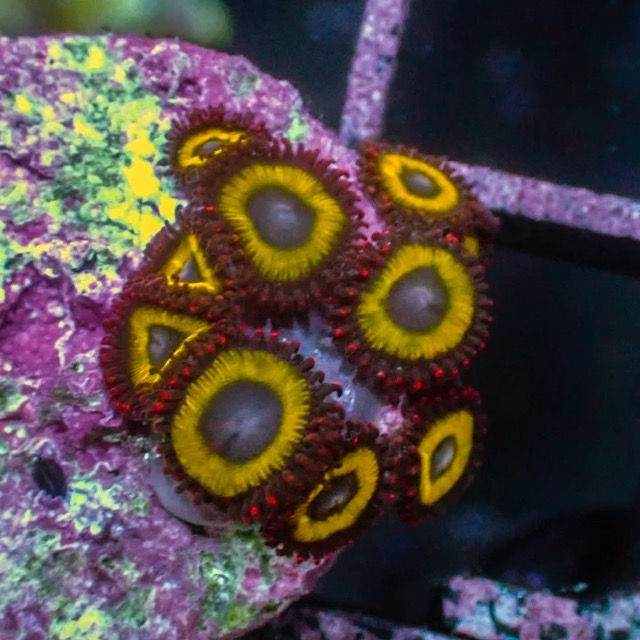
Belladonna Coral Frag
Corail Belladonna.


Description
Le corail Belladonna est une superbe variété de zoanthide, très appréciée des aquariophiles pour ses couleurs vives, son cœur lumineux et ses motifs saisissants qui ressortent magnifiquement sous un éclairage récifal. À croissance rapide et facile à maintenir, ce zoanthide robuste est idéal pour les aquariophiles récifaux souhaitant créer un jardin de zoanthides coloré ou ajouter une touche spectaculaire à leurs roches et à leurs îlots de boutures.


Que vous soyez un collectionneur chevronné ou que vous débutiez votre récif, le zoanthide Belladonna est un véritable spectacle qui prospère avec un minimum d'entretien.


Informations clés sur l'entretien


✅ Type : Zoanthide (corail mou)


✅ Croissance : Forme des tapis ou des colonies denses – facile à bouturer et à partager.


✅ Comportement : Parfaitement inoffensif pour les récifs et paisible, mais peut étouffer les coraux plus lents si on ne le contrôle pas.


✅ Niveau de difficulté : Facile à modéré – prospère dans des conditions d'eau stables et avec un bon éclairage. ✅ Alimentation : Principalement photosynthétique, mais apprécie un nourrissage ciblé occasionnel avec des aliments pour coraux ou des acides aminés.


Fragment de corail Belladonna : 3 à 4 polypes par fragment
What is the Belladonna Coral?
The Belladonna Coral is a designer Zoanthid — a type of colonial polyp coral popular for its vivid colors, striking patterns, and ease of care. While “Belladonna” isn’t a scientific name, it’s a trade name used by coral farmers and frag sellers to describe a zoa morph that typically features deep purples, bright blues, or neon centers with contrasting rings.
Like other zoas, Belladonnas are prized for their intense fluorescence under reef lighting and their ability to quickly form dense mats over rockwork, frag racks, or island scapes.
Why Reef Hobbyists Love Belladonna Zoas
✅ Eye-catching color morph — vivid, glowing centers with dramatic rings or skirts.
✅ Beginner-friendly — hardy, adaptable, and fast-growing under proper conditions.
✅ Perfect for fragging — easily shared or traded with other reefers.
✅ Great for adding pops of color to nano reefs, mixed reefs, or dedicated Zoa gardens.
✅ Reef Safety & Behavior
✔️ 100% reef safe.
✔️ Non-aggressive — plays well with other corals but can outcompete nearby slow growers if not trimmed back.
✔️ Zoanthids do contain palytoxin — always handle with care and wear gloves and eye protection when fragging.
✅ Care Level
-
Difficulty: Easy to Moderate — great for beginners but thrives with stable water and decent lighting.
-
Placement: Low to mid-level in the tank — prefers moderate light and moderate to strong flow to keep debris off the polyps.
-
Diet: Primarily photosynthetic — they thrive under good reef lights but can benefit from occasional target feeding of small coral foods like Reef Roids or amino acids.
Water Conditions
-
Temperature: 72–78°F
-
Salinity: 1.024–1.026 SG
-
pH: 8.1–8.4
-
Keep nitrates and phosphates low but not zero — zoas like “dirty” water more than SPS corals.
-
Stable alkalinity and calcium levels support healthy growth.
Tank Mates
✅ Perfect for mixed reefs — peaceful with other softies, LPS, and SPS.
✅ Compatible with reef-safe fish, shrimp, crabs, and snails.
❌ Avoid aggressive coral species that might shade or sting them.
Fun Fact
Many hobbyists build entire Zoa gardens with multiple morphs like Belladonna, Pandora, Fruit Loops, and Rastas — creating a colorful mat of mixed zoas that really pops under actinic lighting!